
Press

Fashion Network draws on IADS data on department stores adapting to the post-sneaker
Fashion Network draws on IADS data on department stores adapting to the post-sneaker
Fashion Network covered how global department stores are responding to a maturing sneaker market, using IADS data and member insights across its UK, French, and German editions. According to IADS, footwear accounts for 5% of revenue for women and 3% for men across its members in 2024-2025, with digital channels now driving 43% of women's and 36% of men's footwear sales. The article details how members including Breuninger, El Palacio de Hierro, John Lewis, Galeries Lafayette, Bloomingdale's, and Tryano are recalibrating their footwear offer — shifting towards versatile styles, own-brand development, AI-assisted operations, and exclusive in-store experiences.
Read the Fashion Network articles:

IADS Press release: The great footwear reset - how department stores are navigating the post-sneaker era
IADS Press release: The great footwear reset - how department stores are navigating the post-sneaker era
The global footwear category is undergoing a fundamental recalibration. While sneakers remain a commercial anchor, department stores worldwide are seeing consumer demand shift toward more polished, versatile styles, alongside rising expectations for precision service and immersive experiences that digital channels cannot replicate.
The footwear business across IADS members demonstrates stability in turnover share. Women's shoes maintain a consistent 5% of total business across 2024-2025, while men's shoes hold steady at an average share of 3%. Yet beneath this stability lies significant strategic transformation as department stores rewire their operations, assortments and customer engagement models.
Sneaker recalibration: from explosive growth to strategic rightsizing
Comfort remains the foundation of footwear purchasing across all markets. Brands such as On, Adidas, New Balance, Ugg, Birkenstock and Golden Goose continue to anchor performance. However, the sneaker supercycle that defined the past decade is showing clear signs of maturation.
Breuninger exemplifies this shift. Despite delivering its strongest sneaker performance in 2025, with luxury customers purchasing three pairs of Adidas at once, whereas they previously bought one pair of luxury sneakers, the German department store anticipates reducing the total sneaker share of sales. The company has reviewed its women's sneaker brand assortment, with a focus on Veja, Autry, Axel Arigato, Asics, Adidas and On, which continue growing. The collaboration with Adidas delivered a steady increase in customers under 24, demonstrating that strategic brand partnerships can drive recruitment even as the category matures.
The "return to office" dynamic is also reshaping demand patterns. At El Palacio de Hierro, male customers increasingly seek formal yet comfortable options. Brands like Santoni, equipped with rubber soles, perform well in this emerging segment. John Lewis reports women's trainer sales stabilising after years of explosive growth, with Adidas and New Balance still excelling but ballerinas, Mary Janes and loafers gaining ground. Manor witnesses a similar slowdown in sneakers alongside rising demand for versatile, well-priced styles, reflecting heightened price sensitivity.
Yet sneakers retain strategic importance. Galeries Lafayette is leveraging sneaker momentum to build a lifestyle offering, and is considering creating a space that combines sneakers and ready-to-wear: a "brand destination." The ready-to-wear offering focuses on sport-adjacent pieces such as leggings, athleisure, and everyday wear, designed to increase cross-selling.
Strategic priorities: the missing middle and private-label differentiation
Department stores face a recurring challenge: identifying contemporary brands that bridge luxury and sport at accessible price points with genuine scale potential. Galeries Lafayette has identified several French brands showing promise in this segment: Bobbies, Odaje, Repetto, and Jonak. Sam Edelman serves this role for Tryano in the Middle East.
Premium brand scaling represents another strategic lever. Breuninger focuses on scaling Pomme d'Api, Alohas, Aeyde and Santoni to secure high-value customer segments. Breuninger also aims to increase its private-label share, focusing on high-quality European production.
At Galeries Lafayette, the private label serves as the entry-level brand. The assortment includes carryover styles providing continuity and margins, plus trend-responsive styles. Tryano is exploring private label in footwear following initial success in eveningwear.
Operational excellence: service precision and experiential differentiation
Service innovation is becoming a competitive differentiator. Breuninger's Stuttgart flagship has deployed dedicated “runners” on Fridays and Saturdays in the women's shoe section. Sales associates scan shoe barcodes and select the required sizes; shoes are delivered to the shop floor within 1 to 3 minutes, depending on traffic. During weekdays, associates can both sell and act as runners. The efficiency of this system in both service quality and sales uplift demonstrates that operational precision directly impacts commercial performance.
Store reinvestment demonstrates commitment to physical retail. John Lewis is updating flagship locations, including Oxford Street and Bluewater, to deliver exceptional customer experiences. Boyner's store layout emphasises newness by shifting the brand mix toward more affordable luxury brands. El Palacio de Hierro plans to double its exposure of contemporary and luxury shoes, with a presence both on the shoe floor and in ready-to-wear shop-in-shops, to drive traffic and cross-selling.
VIC (Very Important Customer) programming has become a strategic priority. Level Shoes drives loyalty through curated brand events; El Palacio de Hierro hosts VIC dinner experiences in partnership with top luxury brands; Sogo in Hong Kong offers brand workshops centred on craftsmanship storytelling. Going further, Breuninger organised an exclusive behind-the-scenes visit to a luxury Italian production facility for top clients , turning provenance and craftsmanship into a memorable loyalty tool.
Pop-up activations have become universal tactical tools. Tryano deploys in-store activations and pop-ups featuring Aquazzura, Ugg and Axel Arigato alongside On. Bloomingdale's organised an On pop-up in its NYC 59th Street dedicated space, and events with Veja and Ugg. Galeries Lafayette's pop-up strategy featured an Ugg takeover in the Champs-Élysées store during Paris Fashion Week. El Palacio de Hierro's portfolio spans Moon Boot, Zegna, Santoni and more. Boyner collaborates with Tommy Hilfiger, Calvin Klein and Guess. Breuninger's interactive Copenhagen Studios pop-up in Munich featured influencer activations that leveraged digital creators' audiences to drive foot traffic.
Digital penetration and AI adoption
Online penetration for women's shoes has climbed to an average of 43% of category sales. Men's shoes show lower digital adoption, with an average share of 36%.
Breuninger has scaled online inventory for top-selling styles, ensuring availability and conversion. Boyner develops its marketplace by onboarding new brands to expand digital assortment. Galeries Lafayette reviews assortment, architecture, and open-to-buy allocation for leading brands.
AI is transitioning from experimentation to practical application. Tryano will relaunch e-commerce in 2026 using AI in photo shoots to improve efficiency. The Chalhoub Group has developed an AI assistant for its beauty app, FACES, which has led to longer time spent and higher conversion rates, an initiative that could transfer to other categories. Bloomingdale's is considering AI to optimise floor space and productivity. Boyner uses AI to monitor competitors' prices online.
Retail design principles reshaping footwear environments
Mid-market retailers are investing heavily in elevated store environments, sometimes rivalling luxury merchants on aesthetics. The "less is more" philosophy is filtering from luxury to mass market. As noted by IADS partner and retail analyst Newstores, Zara now employs spacious, edited displays helping customers feel relaxed rather than overwhelmed.
Lifestyle merchandising has become essential. Footwear is increasingly integrated with clothing and accessories as complete lifestyle presentations, as exemplified by Banana Republic's NYC flagship. Standalone shoe shops are becoming rare as category mixing drives additional sales.
Lower-priced retailers face the challenge of maintaining stock depth while projecting an aspirational atmosphere. Primark demonstrates how keeping low displays for shoes with multiple sizes allows sightlines while maintaining density without a discount feel.
Lighting has emerged as the single most critical design element. Marks & Spencer's newly opened Bath store uses backlit shelves and overhead spots to create hero lighting, strategically placing white shoes midway along walls to draw the eye across entire shelves. The principle: light the merchandise, not just the space.
The footwear category stands at an inflexion point. Department stores are actively reshaping their businesses through strategic brand curation, operational precision, immersive experiences, and service innovations that build community. While comfort-driven categories continue to anchor performance, the market is shifting toward polished, versatile styles balancing elegance with ease. Physical retail is justifying its existence through experiences that cannot be replicated digitally, VIC programming that builds loyalty, and service precision that customers can feel. In a world of infinite digital choice, department stores are demonstrating that the most powerful competitive advantage remains the ability to make customers feel that a physical space was designed for them.
Newstores is a service that delivers daily information about stores that have just opened, been refurbished or remodelled. It analyses what this means for the market and where it points in terms of trends and the direction that retail is taking. Newstores provides a global view of what’s happening from Seoul to London, and from Mexico to Dubai. Issuing four annual trend reports detailing the major moves, Newstores helps retailers make informed decisions. Newstores is compiled, edited and written by John Ryan, a retailer and journalist with more than 30 years of experience, covering all categories, from food to fashion.
Contact: johnhilldown@aol.com
The International Association of Department Stores (IADS) is the only expert body specialising globally in the department store retail format. Consisting of leading department store members worldwide, the Association serves as an international network that facilitates exchange and communication among its members. It also conducts research to address the current challenges of department stores and provide actionable insights for its members.
Today, IADS permanent members include Almacenes Siman (El Salvador, Guatemala, Nicaragua, and Costa Rica), Beijing Hualian Group (PRC), Bloomingdale’s (USA), Boyner (Turkey), Breuninger (Germany), Chalhoub Group (UAE), Centro Beco (Venezuela), El Corte Inglés (Spain), El Palacio de Hierro (Mexico), Falabella (Chile, Colombia and Peru), Galeries Lafayette (France), John Lewis & Partners (UK), Lifestyle International Holding (Hong Kong), Magasin du Nord (Denmark), Manor (Switzerland), The Mall Group (Thailand), TSUM Kyiv (Ukraine). These retail leaders are joined by a network of other department stores and retail companies as corresponding members.
Together, the IADS members, all key players in their respective markets, create a landscape of diverse business models and cultures, representing more than € 41billion in combined annual turnover, achieved through over 563 stores with 257,000 associates in 32 countries.
Through its activities and partnerships with Retail Hub, RH-ISAC, and Newstores, the Association remains constantly up to date on its members’ questions and challenges. It generates solution-driven problem-solving processes for its members, preparing them to face the future of the retail industry.
Press Contact: IADS, press@iads.org
Read the full press release below:
Download the full press release, in English, here.
Read the full press release, in French, below:
Business of Fashion features Almacenes Simán joining IADS in global markets brief
Business of Fashion features Almacenes Simán joining IADS in global markets brief
Business of Fashion's "Worldview" global markets brief reported on Central America's largest department store Almacenes Simán joining IADS. The San Salvador-based retailer, founded in 1921, operates 15 department stores across El Salvador, Guatemala, Nicaragua and Costa Rica. The article notes that Almacenes Simán joins fellow IADS members from Latin America including El Palacio de Hierro, Centro Beco and Falabella.
Read the full Business of Fashion article below:
Worldview | Brazilian Fashion Set to Gain from Mercosur-EU Trade Deal
IADS Press release: Almacenes Simán joins the International Association of Department Stores
IADS Press release: Almacenes Simán joins the International Association of Department Stores
Almacenes Simán, the largest and most influential department store group in Central America and a fourth-generation family-owned business, joins the IADS. Renowned for its unique dual role as a premier department store operator and a regional franchise partner for major global brands, and for its trusted retail heritage spanning over a century, Almacenes Simán is the first department store company from Central America to join the IADS since its inception in 1928.
Founded in 1921 by José J. Simán as a modest fabric-and-notions shop in San Salvador, Almacenes Simán has since evolved into the region's leading retail brand. With a rich heritage of adapting to local tastes while importing global standards, the company now operates a robust network of 15 full-line department stores across El Salvador, Guatemala, Nicaragua, and Costa Rica. These physical anchors are complemented by a growing digital ecosystem, including country-specific e-commerce platforms and the recently launched "Simán Express" format—satellite locations dedicated to click-and-collect services and curated assortments—demonstrating a sophisticated omnichannel strategy that bridges the physical and digital worlds.
The company’s commitment to world-class retail experiences is best exemplified by its modern flagships, such as the store at Lifestyle Center La Gran Vía in El Salvador, Multiplaza Escazú in Costa Rica and Miraflores Mall in Guatemala. Designed in collaboration with international firms such as Instore from Chile and Neumann & Rudy from New York, these retail destinations feature monumental façades, 18-foot ceilings, and a contemporary aesthetic that eschews traditional vernacular in favour of a truly international feel. These investments are part of a broader strategy to position Siman not just as a store, but as a lifestyle hub, anchoring the best shopping centres in Central America.
What truly sets Almacenes Simán apart is its unique hybrid business model within the Alsicorp structure. While maintaining its identity as a classic generalist department store offering fashion, home, beauty, and technology, the group also serves as a critical gateway for international retail in Central America. Through its sister entities, the group manages a vast portfolio of franchise operations for global giants, including Inditex brands (Zara, Massimo Dutti, Bershka, etc.), and is a key partner for major brands’ wholesale operations like Tendam, El Corte Inglés, Bestseller, Estee Lauder, and Samsung. This distinct operational structure allows Simán to leverage deep regional expertise across multiple formats, blending the exclusivity of a private department store with the agility of fast-fashion franchising.
In recent years, Almacenes Simán has solidified its reputation as a socially responsible corporate citizen. Celebrating over 100 years of history, the company has leveraged its centenary to reinforce employer branding and community engagement, positioning itself as a stable, professional, and values-driven employer in the region. This commitment extends to its customer base through a financial ecosystem that includes proprietary credit cards, fostering high loyalty and accessibility for middle- and upper-middle-income families across Central America.
By joining the Association, Almacenes Simán will contribute invaluable insights into managing complex, multi-country regional operations and successfully integrating franchise partnerships within a department store portfolio. Their membership strengthens the IADS framework, opening new avenues for collaboration on strategic challenges, from cross-border logistical integration to the modernisation of legacy retail brands in emerging markets.
About Almacenes Simán
Almacenes Simán is the largest department store chain in Central America. A Salvadoran company founded in 1921, it is headquartered in San Salvador, El Salvador, and has a presence throughout Central America. For over a century, the brand has established itself as a regional benchmark by offering a wide variety of products, including fashion, beauty, home goods, technology, and activewear, creating shopping experiences that combine quality, style, and service. As part of its value proposition, Simán offers financial solutions through Credisimán, its private label credit card, and Credisimán Visa, an international credit card that provides customers with greater flexibility, benefits, and access to exclusive services. Committed to the region's development, Almacenes Simán drives initiatives that create value for its customers, employees, and communities.
About IADS
The International Association of Department Stores (IADS) is the only expert body specialising globally in the department store retail format. Consisting of leading department store members worldwide, the Association serves as an international network that facilitates exchange and communication among its members. It also conducts research to address the current challenges of department stores and provide actionable insights for its members.
Today, IADS permanent members include Beijing Hualian Group (PRC), Bloomingdale’s (USA), Boyner (Turkey), Breuninger (Germany), Chalhoub Group (UAE), Centro Beco (Venezuela), El Corte Inglés (Spain), El Palacio de Hierro (Mexico), Falabella (Chile, Colombia and Peru), Galeries Lafayette (France), John Lewis & Partners (UK), Lifestyle International Holding (Hong Kong), Magasin du Nord (Denmark), Manor (Switzerland), The Mall Group (Thailand), TSUM Kyiv (Ukraine). These retail leaders are joined by a network of other department stores and retail companies as corresponding members.
Together, the IADS members, all key players in their respective markets, create a landscape of diverse business models and cultures, representing more than €40.5 billion in cumulated annual turnover, achieved through over 549 stores with 251,000 associates in 28 countries.
Through its activities and partnerships with Retail Hub, RH-ISAC, and Newstores, the Association remains constantly up to date on its members’ questions and challenges. It generates solution-driven problem-solving processes for its members, preparing them to face the future of the retail industry.
Press Contact: IADS, press@iads.org
Read the full press release below:
Download the full press release, in English, here.
Read the full press release, in French, below:
Central do Varejo spotlights luxury retail panel moderated by IADS at the World Retail Congress
Central do Varejo spotlights luxury retail panel moderated by IADS at the World Retail Congress
Central do Varejo covered the "Future of Luxury" panel at the World Retail Congress, moderated by the IADS Managing Director, Selvane Mohandas du Ménil. The IADS presented data showing the luxury sector has lost €140 billion in market value and 50 million consumers since 2022. The discussion with executives from Selfridges, Diriyah Company, and Christian Louboutin explored the sector's evolution toward experience-driven models.
Read the full Central do Varejo article below:
World Retail Congress debate o futuro do luxo entre tradição, experiência e novas regras do consumo
iMille reports on IADS naming Robert Rooderkerk as first academic advisor
iMille reports on IADS naming Robert Rooderkerk as first academic advisor
iMille covered IADS's appointment of Robert Rooderkerk (Rotterdam School of Management) as the association's first academic adviser. The article highlights his expertise in omnichannel retail and retail analytics, and his role in supporting IADS Academy programmes, white papers and member knowledge transfer.
Read the full iMille article below:
Robert Rooderkerk joins IADS to lead research and innovation in retail
IADS Press release: IADS appoints an Academic Advisor
IADS Press release: IADS appoints an Academic Advisor
The International Association of Department Stores appoints first-ever Academic Advisor in 98-Year history.
Dr. Robert Rooderkerk of Rotterdam School of Management joins International Association of Department Stores to elevate thought leadership, research access, and strategic guidance for global department store leaders.
The International Association of Department Stores (IADS) has appointed Dr. Robert Rooderkerk, Associate Professor of Operations Management at Rotterdam School of Management, Erasmus University, as its first academic advisor. The decision was taken during the IADS General Assembly in Hong Kong in November 2025, marking a historic milestone for the Association founded in 1928.
Dr. Rooderkerk brings extensive expertise at the intersection of marketing and operations, with a specific focus on omnichannel retail and retail analytics. His appointment reflects IADS's commitment to strengthening thought leadership and providing its members with access to cutting-edge academic research and management frameworks tailored to the evolving challenges facing department stores worldwide.
As founding Academic Director of the MScBA Business Analytics & Management programme at Rotterdam School of Management—ranked 20th globally out of 200+ analytics programmes according to 2025 QS rankings—Dr. Rooderkerk has demonstrated proven capacity to translate academic insight into practical business value. He serves on the editorial board of Journal of Retailing and Production and Operations Management and leads the Retail Analytics Expert Practice at the Erasmus Centre for Data Analytics. Recently, Dr. Rooderkerk has led the development of a dedicated analytics track within RSM’s Full-Time MBA program, spearheading both the design and delivery of the new course Leading with Analytics: From Insights to Impact, which equips future leaders to create business value with decision-driven analytics. Dr. Rooderkerk also co-teaches a highly popular Retail Operations elective in RSM’s undergraduate program.
His research addresses critical retail challenges including the value of experience-centric stores, online fulfilment failures, sustainable assortment planning, and dynamic store staffing. Published in leading academic journals such as Production and Operations Management, Marketing Science, Journal of Marketing Research, and management outlets including California Management Review and Harvard Business Review, his work has earned recognition including the Dutch Marketing Science Award and finalist positions for the Journal of Marketing Research best paper award.
In this advisor role, Dr. Rooderkerk will support IADS across three strategic pillars: improving knowledge transfer between members through more structured and actionable meeting formats; providing digestible external insights on analytics, innovation, and organisational design; and amplifying the department stores' industry voice. His collaboration with IADS will include contributions to the annual IADS Academy programme, white papers, case study development, and tailored in-house events for member companies.
Dr. Rooderkerk has collaborated with retailers, manufacturers, industry networks, and public organisations including Coca-Cola, Coolblue, Heineken, Jumbo Supermarkten, Philips, and the Dutch Ministry of Economic Affairs. Several methods he developed, including assortment optimisation frameworks, have been implemented by companies across sectors. He has held visiting positions at the University of Florida, Tuck School of Business at Dartmouth, UCLA Anderson School of Management, and HEC Paris. In recognition of his ability to bridge retail academia and practice, Rethink Retail has recently named Dr. Rooderkerk a 2026 Top Retail Expert.
The appointment strengthens IADS's ability to deliver solution-driven insights to its members. Dr. Rooderkerk's work will complement the Association's existing partnerships with Retail Hub, RH-ISAC, and Newstores, ensuring members remain at the forefront of retail innovation and best practice.
Rotterdam School of Management, Erasmus University (RSM) is the international business school of Erasmus University Rotterdam, located in the vibrant port city of Rotterdam and consistently recognised as one of Europe’s leading business schools. RSM holds the prestigious Triple Crown accreditation from AACSB International, EQUIS and AMBA, a distinction achieved by only about 1% of business schools worldwide. According to the Financial Times, RSM ranks #1 in the Benelux for its MBA and EMBA programmes and #1 in Europe for business research impact, underscoring its strength in both academic excellence and professional education. Offering a comprehensive portfolio of BSc, MSc, MBA, PhD and executive programmes, RSM integrates rigorous research with real-world relevance, emphasising responsible leadership, sustainability and data-driven decision-making. With a highly international student body and faculty, strong corporate partnerships, and an alumni network spanning more than 150 countries, RSM prepares graduates to become positive change-makers in a rapidly evolving global economy.
The International Association of Department Stores (IADS) is the only expert body specialising globally in the department store retail format. Consisting of leading department store members worldwide, the Association serves as an international network that facilitates exchange and communication among its members. It also conducts research to address the current challenges of department stores and provide actionable insights for its members.
Today, IADS permanent members include Beijing Hualian Group (PRC), Bloomingdale’s (USA), Boyner (Turkey), Breuninger (Germany), Chalhoub Group (UAE), Centro Beco (Venezuela), El Corte Inglés (Spain), El Palacio de Hierro (Mexico), Falabella (Chile, Colombia and Peru), Galeries Lafayette (France), John Lewis & Partners (UK), Lifestyle International Holding (Hong Kong), Magasin du Nord (Denmark), Manor (Switzerland), The Mall Group (Thailand), TSUM Kyiv (Ukraine). These retail leaders are joined by a network of other department stores and retail companies as corresponding members.
Together, the IADS members, all key players in their respective markets, create a landscape of diverse business models and cultures, representing more than €40.5 billion in cumulated annual turnover, achieved through over 549 stores with 251,000 associates in 28 countries.
Through its activities and partnerships with Retail Hub, RH-ISAC, and Newstores, the Association remains constantly up to date on its members’ questions and challenges. It generates solution-driven problem-solving processes for its members, preparing them to face the future of the retail industry.
About the IADS Academy
The IADS Academy is an IADS transformative initiative started 30 years ago to help develop young talented executives into future leaders. During the 9-month programme, participants are asked to provide concrete and actionable answers to a question raised by CEO members. To that end, they learn, exchange and are empowered to solve a problem with a C-level vision. The IADS Academy allows them to foster relationships in a multi-cultural, multi-skilled group and gain a broader perspective on the operations of department stores.
Among current members, 3 CEOs and 1 COO are Academy Alumni. Over 30 years of existence, 29 companies from 22 countries have participated and the Academy trained 160+ high potential executives.
About the IADS White Paper collection
In its role of researching and documenting the most pressing challenges department stores face, the IADS produces an annual report for its members and the general public. The 2020 edition reflected on lessons from the pandemic. Then in 2021, the IADS White Paper examined digital transformation and its organisational impact. The 2022 edition analysed sustainability, CSR and ESG. In 2023, retail media and monetisation ecosystems were explored. And in 2024, the White Paper highlighted the crucial role of middle management.
Faithful to its mission of sharing insights with the general public and true to its vision of abolishing boundaries, the IADS makes its current and past White Paper digital issues available on its website (link: https://www.iads.org/white-papers). Hard copies can also be provided upon request.
Press Contact: IADS, press@iads.org
Read the full press release below:
Download the full press release, in English, here.
Read the full press release, in French, below:
Download the full press release, in French, here.
WWD profiles IADS appointment of Robert Rooderkerk as first academic adviser
WWD profiles IADS appointment of Robert Rooderkerk as first academic adviser
WWD covered IADS's appointment of Robert Rooderkerk (Rotterdam School of Management) as its first academic adviser. The role will support knowledge transfer across members and contribute to the IADS Academy programme, white papers, and case studies. Rooderkerk's research focus includes omnichannel retail, retail analytics, and experience-led store formats.
Read the full WWD article below:
IADS Names Robert Rooderkerk as First Academic Adviser to Boost Retail Research, Strategy Support
WWD quotes IADS on department store tactics for music tourism in Paris
WWD quotes IADS on department store tactics for music tourism in Paris
WWD featured IADS Managing Director Selvane Mohandas du Ménil on retail strategies for Celine Dion's 16-concert Paris residency this autumn. Du Ménil drew on IADS member precedents from K-pop tours in Asia — including activations by Lotte Department Store, Hyundai, and Sogo Hong Kong — and pointed to a potential "post-event glow" following the concerts.
Read the full WWD article below:
Paris Retailers Advised to Capitalize on 'Celine Dion Effect'
Fashion Network Italy analyses IADS study on department store shift to customer continuity
Fashion Network Italy analyses IADS study on department store shift to customer continuity
Fashion Network Italy analysed IADS’s latest research, introducing "customer continuity" as the next evolution beyond traditional omnichannel retail. The study highlights how department stores are moving from channel-based logic to unified customer journeys, measuring success through customer lifetime value rather than single-channel revenue. The article details member case studies from Breuninger's local orchestration, Boyner's 90-minute delivery, and Chalhoub Group's AI assistant "Layla.”
Read the full Fashion Network article below:
L’IADS promuove la "continuità cliente" in uno studio su omnicanalità e grandi magazzini
Paris Match features IADS on art's transformation in department store retail
Paris Match features IADS on art's transformation in department store retail
Paris Match explored the historical and contemporary role of art in department stores, quoting IADS on the evolution from window displays to permanent collections. The feature highlights installations at Galeries Lafayette and Centre Pompidou-Metz during Paris Fashion Week, and the pioneering art programs of Japanese department stores.
Read the full Paris Match article below:
«Les artistes sont passés des vitrines à des collections permanentes » : l'art, cet invité de marque
Modaes covers IADS data on a cooling department store recovery and regional disparities
Modaes covers IADS data on a cooling department store recovery and regional disparities
Modaes explores the IADS Global Department Store Monitor, finding the sector's post-pandemic recovery has effectively stalled, near-flat growth in 2025 after declining the year prior. The report identifies a 'vibecession'—a disconnect between macroeconomic stability and defensive consumer behaviour—with Latin America and India showing resilience while China and Hong Kong face structural challenges, and retailers shifting towards AI-powered inventory management and generative engine optimisation.
Read the full Modaes article:
Los grandes almacenes pinchan: el consumo enfría su recuperación global
Fashion Network examines IADS study on 'customer continuity' in omnichannel retail across four editions
Fashion Network examines IADS study on 'customer continuity' in omnichannel retail across four editions
Fashion Network covered the IADS's March 9 Press Release on omnichannel retail across four regional editions: UK, French, Turkish and Portuguese. The IADS study argues that 'omnichannel' has become an outdated concept, proposing 'customer continuity' as a new operating model that prioritises end-to-end customer journeys, unified customer identity, and lifetime value over channel-specific metrics. Member initiatives from Breuninger, Boyner, The Mall Group, Falabella, Chalhoub Group, and John Lewis illustrate four transformation levers: trade-area orchestration, app-first continuity, precision fulfilment, and AI-driven clienteling. Implementation at scale is planned across IADS members over the next 18 months.
Read the full Fashion Network articles:
Click here to read the IADS’ Omnichannel Press Release
RetailDetail covers IADS findings on department stores betting on AI and secondhand
RetailDetail covers IADS findings on department stores betting on AI and secondhand
RetailDetail Belgium reports on the IADS Global Department Store Monitor, which analysed 58 department stores worldwide and found revenue stabilised at 0.63% growth in 2024–2025, following a 1.6% contraction the previous year. Retailers are responding to cautious consumer spending and supply chain disruptions through AI adoption and expansion into the secondhand market.
Read the full RetailDetail article below:
Large department stores, which are losing momentum, are betting on AI and the second-hand market
WWD reports on IADS data showing department store rebound stalls in 'vibecession'
WWD reports on IADS data showing department store rebound stalls in 'vibecession'
WWD reports on the IADS Global Department Store Monitor, which reveals department store sales rose just 0.63% in the 2024–2025 financial year across 58 stores globally—reflecting what industry executives describe as a 'vibecession.' The study highlights a growing disconnect between improved macroeconomic indicators and muted consumer confidence, with retailers leaning on promotions, AI-driven efficiency, and generative engine optimisation as Middle East tensions, tariffs, and currency fluctuations weigh on fragile consumer sentiment.
Read the full WWD article below:
Department store rebound stalls in ‘Vibecession’ as Middle East tensions weigh on consumer confidence
Click here to read the IADS’ Global Department Store Monitor Press Release
IADS Press Release: IADS Global Department Store Monitor 2024 - 2025
IADS Press Release: IADS Global Department Store Monitor 2024 - 2025
Global department store sales stabilise at +0.63% during the ‘vibecession’: macroeconomic growth meets cautious consumers amid currency chaos.
The 2026 edition of the IADS Global Department Store Monitor reviews 58 department stores worldwide for fiscal year 2024-2025, revealing modest sales stabilisation despite persistent economic uncertainty. After two consecutive years of post-COVID growth followed by a slight contraction in 2023-2024 (-1.6%), global department store sales recovered to average +0.63% year-on-year growth, marking cautious normalisation rather than robust expansion.
The economic paradox: soft landing meets renewed volatility
Fiscal year 2024-2025 opened with unexpected resilience. The global economy performed better than forecasted, achieving what many economists termed a “soft landing”—controlled inflation without recession. However, this stability proved short-lived. Donald Trump’s re-election as U.S. President in November 2024 triggered a shift toward aggressive protectionism. His entry into office in early 2025 ushered in a period of see-sawing tariffs, trade renegotiations, and supply chain disruptions, adding uncertainty to an already strained global logistics network.
For the retail sector, this created a paradox: while macroeconomic indicators showed improvement—reduced inflation, steady GDP growth—consumers remained deeply price-sensitive and value-driven. This disconnect, termed the ‘vibecession’ by economists, forced retailers to rely heavily on promotions and AI-driven operational efficiency to maintain margins. Department stores found themselves navigating not just economic headwinds but a fundamental crisis of consumer confidence decoupled from underlying economic fundamentals.
The IADS Monitor: measuring performance in turbulent times
Launched in 2021, the IADS Global Department Store Monitor was designed to make department stores’ financial results comparable and comprehensible across a complex sector characterised by changes in ownership, privatisation, and mergers. The Monitor isolates the impact of sales growth from exchange rate effects by using both current and fixed (2021) exchange rates. To account for non-uniform accounting standards, the broken-calendar-year system ensures that retailers’ results are compared against the same global events.
This methodology proved essential in fiscal year 2024-2025. Currency fluctuations, often driven by divergent central bank policies and geopolitical risk premiums, created a stark divide between nominal and real growth.
Currency volatility: the invisible hand reshaping retail
Exchange rate movements fundamentally altered department store performance across regions. While many retailers reported sales growth in local currency terms, these gains often evaporated when converted to reporting currencies due to unfavourable exchange rates. Conversely, currency weakness reshaped international tourism flows: countries with weaker currencies attracted high-spending tourists, boosting retail sectors, while those with stronger currencies faced domestic spending leakage to cheaper destinations.
The impact of tariff uncertainty compounded these effects. Retailers across markets accelerated inventory purchases ahead of anticipated tariff implementations, distorting typical seasonal buying patterns and creating short-term sales spikes that obscured longer-term softness in demand. Supply chain reconfigurations such as shifting sourcing from China to Vietnam, Mexico, or Eastern Europe introduced new currency exposure risks that many department stores were unprepared to hedge effectively.
Japan exemplified currency dynamics—and their risks. The weak yen drove Japanese department stores to record sales of 5.75 trillion yen in 2024, surpassing pre-pandemic levels. Major players, including H2O (+8%), J Front Retailing (+10.1%), and Takashimaya (+6.9%), posted strong gains, fuelled by duty-free sales and Chinese tourism. However, this boom proved unsustainable: by mid-2025, the yen’s appreciation and persistent inflation caused tax-free sales to plummet 40% year-on-year. More recently, a diplomatically driven boycott by Chinese tourists in March 2026 exposed the sector’s historic over-reliance on inbound luxury spending. This demand shifted, with South Korean department stores reporting record-high foreign sales as Chinese consumers redirected spending to Seoul.
Regional analysis: three divergent paths emerge through economic turbulence
The IADS sample, composed of 58 department stores with publicly available information, revealed three permeable categories: organic growth in emerging markets and Southern Europe, strong currency effects in East Asia, and cautious consumer sentiment in mature markets.
- Latin America demonstrated resilience, with Falabella (+10.2%), Liverpool (+9.6%), and Cencosud Paris (+5.4%) achieving growth despite currency appreciation. They leveraged high consumer confidence and multichannel adaptations to navigate economic headwinds, benefiting from domestic consumption patterns relatively insulated from U.S.-China trade tensions.
- India emerged as a growth leader, with Lifestyle (+6%) and Shoppers Stop (+5.2%) capitalising on rising discretionary spending among affluent, digitally engaged consumers. The market’s maturation accelerated with Galeries Lafayette‘s November 2025 flagship opening in Mumbai, in partnership with Aditya Birla Group.
- In contrast, China and Hong Kong faced a structural reset driven by the property crisis and weak consumption, challenges intensified by tariff threats that deterred both domestic consumption and international investment. Parkson Retail Group (-13.6%), Wangfujing (-7%), and Maoye (-13.2%) all declined, while Hong Kong’s Wing On (-10.41%) struggled as currency depreciation made shopping in Shenzhen cheaper for both locals and mainland Chinese consumers. The concentration of Chinese department stores in real estate-dependent business models also proved challenging as property valuations collapsed.
- Southern Europe thrived on a tourism super-cycle, as El Corte Inglés (+2.3%), La Rinascente (+4.3%), and Attica (+8.8%) leveraged a weak euro to attract high-spending non-EU visitors (especially Americans). Conversely, Northern Europe and Scandinavia struggled as currency weakness fuelled inflation rather than tourism, leading to stagnating sales and strategic restructuring for players like Stockmann. While the ongoing absence of tax-free shopping has suppressed international spending across the UK, some retailers are still finding stability. John Lewis announced a 2% staff bonus in March 2026, signalling a resilient domestic performance.
- The U.S. market experienced significant volatility shaped directly by policy uncertainty. Major retailers, including Macy’s, Dillard’s, and Kohl’s, faced contraction as consumers delayed big-ticket purchases amid tariff confusion and inflation concerns. The Saks Global bankruptcy in January 2026, following its USD 2.7 billion acquisition of Neiman Marcus Group just months earlier, sent shockwaves through the industry.
Structural shifts: digital transformation and physical retail renaissance
Beyond currency effects, fiscal year 2024-2025 marked key operational transformations. AI usage transitioned from experimental deployment to operational efficiency, with retailers prioritising backend improvements—inventory optimisation, dynamic pricing, supply chain forecasting—over consumer-facing solutions. The obsolescence of traditional SEO in favour of Generative Engine Optimisation (GEO) altered e-commerce traffic models, forcing retailers to adapt digital storefronts for machine readability to ensure products are recommended by AI agents.
The second-hand and recommerce segment outpaced broader retail growth, with Galeries Lafayette opening second-hand watch and jewellery spaces, while Vinted became the top clothing retailer in France. The personal luxury goods market declined 2% in 2024, with aspirational luxury consumption dropping sharply among Gen Z.
Simultaneously, physical retail experienced a renaissance of quality over quantity. While total store counts stabilised, retailers closed underperforming locations to fund experiential flagships, prioritising immersive experiences over footprint expansion.
Outlook: navigating geopolitical and economic turbulence
The next edition will examine fiscal year 2025-2026 results against an even more volatile backdrop. The second year of the Trump administration has entrenched a protectionist agenda characterised by aggressive tariffs restructuring global retail supply chains. Policy whiplash, including abrupt tariff announcements, sudden reversals, and exemptions granted and rescinded, has made long-term forecasting difficult, forcing retailers to sacrifice growth in favour of resilience.
Concurrently, the escalation of conflict in the Middle East has strained global logistics corridors and impacted key macroeconomic indicators. Energy price volatility has created additional inflationary pressure precisely as central banks attempt to normalise monetary policy, threatening the fragile consumer confidence.
Shifting consumer behaviours, shaped by the persistent ‘vibecession’—a disconnect between improving macroeconomic indicators and negative consumer sentiment—show no signs of resolution.
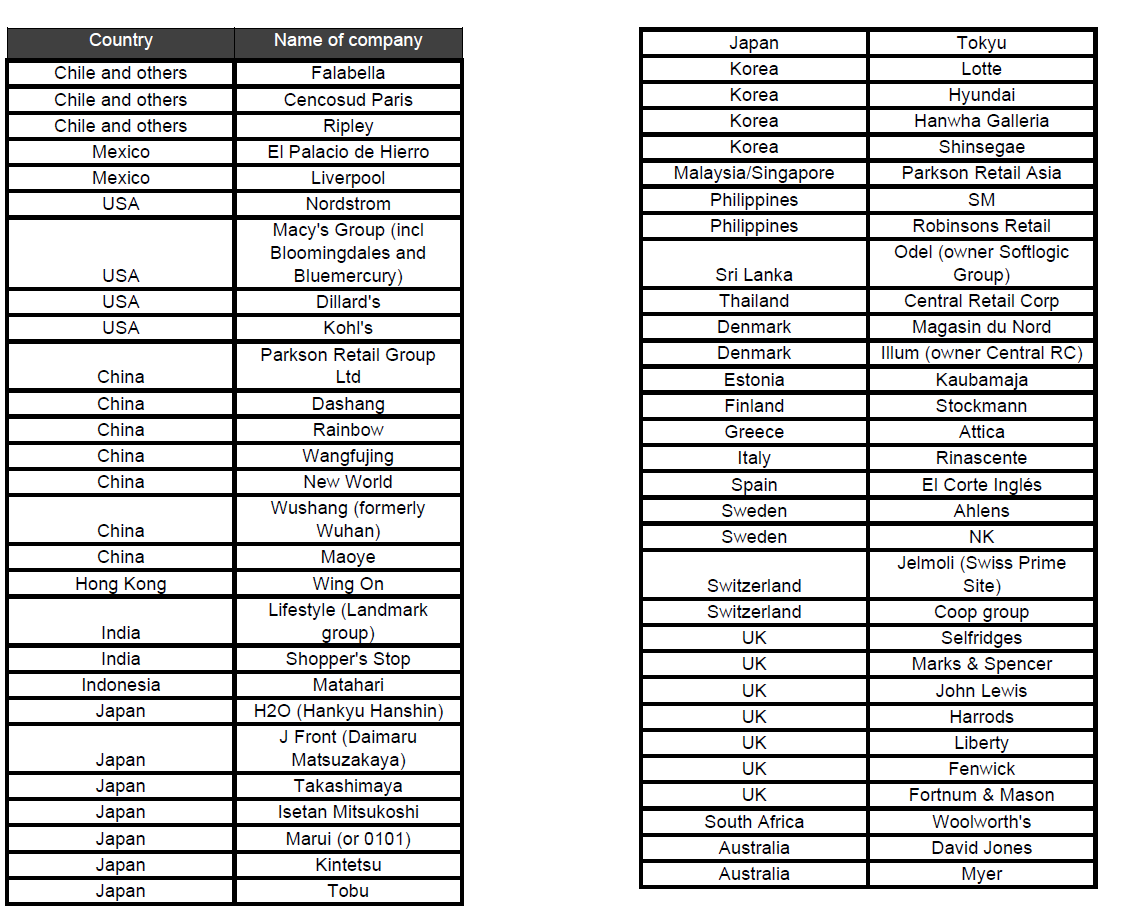
The full list of companies covered in the Global Department Store Monitor is available below. The data sheet can be downloaded by clicking here.
List of companies updated in the IADS Global Department Store Monitor list
Read the full press release below:
IADS PRESS RELEASE: IADS Global Department Store Monitor
Read the full press release, in French, below:
IADS Communiqué de press: IADS Global Department Store Monitor
Access the IADS Global Department Store Monitor datasheet here:
IADS Global Department Store Monitor datasheet
Textilwirtschaft examines department store stabilisation with the IADS Global Monitor data
Textilwirtschaft examines department store stabilisation with the IADS Global Monitor data
Textilwirtschaft reported on the IADS Global Department Store Monitor, examining trends in department store business performance and market conditions.
Read the full Textilwirtschaft article below:
Department Stores: Stabilisiert sich das Business?
IADS Press release : Omnichannel 2025
IADS Press release : Omnichannel 2025
Making “Omnichannel” an outdated phrase: by moving from channel silos to connected customer relationships, department stores are creating a new operating system, the “customer continuity” - fast, precise and convenient.
The great promise of ‘omnichannel’ remains unfulfilled for many department stores, often choked by siloed systems and channel-specific metrics. The new growth mandate is not a technology project but an entirely new operating model: Customer Continuity.
The IADS’ members’ blueprint for “Real Omnichannel” is an executive mandate. It declares the end of the channel silo era, replacing it with connected customer relationships powered by operational precision that customers can feel: fast, clear, and convenient. Success now comes from orchestrating end-to-end journeys, powered by unified customer identity, a strong operational backbone, and trade-area execution—not from adding isolated features. The message is clear: align strategy, technology and culture around continuous customer relationships across every touchpoint.
The strategy: trade-area orchestration and app-first continuity
Department stores are reframing omnichannel as customer continuity, focusing on relational value rather than channel optimisation. Minimising friction between online and offline is key to converting one-time transactions into ongoing relationships. Success is increasingly measured by Customer Lifetime Value (CLV), rather than turnover alone:
- Trade-area execution: This localised strategy recognises that customer journeys are fundamentally local. In Germany, Breuninger successfully moved management from siloed channels to trade-area orchestration, aligning stakeholders and targets across store, app, and web with a single goal: convert local shoppers into omnichannel customers.
- The omnichannel cockpit: The app sits at the centre, connecting discovery, service, and transactions. Others are engineering similar continuity: in Turkey, Boyner builds cross-frequency by moving shoppers both ways—online to store and store to online—through targeted offers, staff-driven app adoption, and their Boyner Now 90-minute delivery promise tied to stores. This approach harnesses stores’ power to lower return rates and build loyalty.
- App utility: in Thailand, The Mall Group’s app recasts loyalty as an omnichannel lifestyle utility where high-use features (parking reservations, AR navigation) lift engagement. While sustained app usage remains a hurdle for most retailers, the levers that work are immediate: proven utility (such as stock and price checks), clear loyalty value, and transforming associates into champions of the digital relationship through store-level competitions.
The engine: precision fulfillment and optimised logistics
Omnichannel growth is increasingly operational. Logistics and fulfilment are no longer cost centres, but growth drivers and customer experience engines.
In Peru, Falabella is the best example. Click-and-collect needs to be placed where it can generate additional sales. Falabella learned that entrance-adjacent pickup consumed premium space, created congestion, and missed cross-sell opportunities. Conversely, routing pickups to the relevant product area when cross-sell potential is high can drive additional sales, allowing the retailer to maintain several collection points while lockers automate low-cross-sell journeys. Also, Falabella stores serve as marketplace nodes to expedite delivery and reduce costs, with most marketplace orders now delivered to stores.
In the Middle East, Chalhoub Group pursues a two-speed transformation: stabilise core systems and then scale growth engines. The lesson for early wins? Accurate customer promises on delivery dates, BOPIS/BORIS options, unified stock merging across stores and warehouses, brand-held stock in one view, and disciplined fulfilment are now brand equity. Visibility of store stock to online demand improves perceived availability and conversion rates. However, design details matter, as overreliance on flagship stores for online fulfilment slows picking and can harm the in-store customer experience.
John Lewis’ Deliver From Store programme tackled the pain of “out of stock” in online product views. Real-time store stock visibility and fulfilment from physical locations shows a profit increase above expectations, with more orders than forecast, evidence that unified commerce and dynamic fulfilment directly bolster customer perception of availability and conversion.
The enabler: intelligence, clienteling, and unified identity
AI is moving from pilot to product, enabling professional-grade clienteling and loyalty. Chalhoub Group’s Layla, an AI beauty assistant built within the FACES app, reduces search fatigue by answering questions and guiding discovery. Early results show increased conversion and additional minutes per average session. The potential to extend category-specific agents to fashion is clear, provided data quality is high and structured not only by attributes but also by benefits and use cases.
The Mall Group is placing AI at the centre of its strategy with M Agent. The six-language concierge combines behavioural data, mall knowledge, and partner content to deliver recommendations, promotion alerts, navigation, booking assistance, and more across social channels, mobile, web, and smart kiosks, balancing PR value, service, and data capture.
Also, clienteling is being professionalised. Breuninger’s software-driven approach closes the loop between visits and follow-ups: their new clienteling tool turns customer walk-ins into relationships, allowing follow-ups and data collection. In the UK, John Lewis prepares to digitise long-standing “little black book” practices. Chalhoub Group is also rebuilding identity and loyalty so benefits and history travel with the shopper across brands and channels. The Muse programme is being re-platformed, with a new app as the loyalty home and a co-branded credit card for card-linked offers online and in-store. Practical touches reduce friction: e-receipts via WhatsApp and an upcoming unified receipt view across web and app. Importantly, clienteling conversations and sales are captured via built-in WhatsApp and email with branded templates, safeguarding continuity even when associates depart. For retailers, loyalty is being rebuilt around a unified identity, so benefits and history follow the shopper, with apps becoming the home for recognition, receipts and card-linked offers.
What’s next for department stores: industrialise what works, measure what matters.
Over the next 18 months, department stores will scale proven plays. The throughline: department stores are rewiring for continuity. Every touchpoint becomes an entry point, every visit a step in a relationship, and every journey a contributor to lifetime value. “Real omnichannel” is no longer a concept; it’s an operating system for growth.
About IADS
The International Association of Department Stores (IADS) is the only expert body specialising globally in the department store retail format. Consisting of leading department store members worldwide, the Association serves as an international network that facilitates exchange and communication among its members. It also conducts research to address the current challenges of department stores and provide actionable insights for its members.
Today, IADS permanent members include Beijing Hualian Group (PRC), Bloomingdale’s (USA), Boyner (Turkey), Breuninger (Germany), Chalhoub Group (UAE), Centro Beco (Venezuela), El Corte Inglés (Spain), El Palacio de Hierro (Mexico), Falabella (Chile, Colombia and Peru), Galeries Lafayette (France), John Lewis & Partners (UK), Lifestyle International Holding (Hong Kong), Magasin du Nord (Denmark), Manor (Switzerland), The Mall Group (Thailand), TSUM Kyiv (Ukraine). These retail leaders are joined by a network of other department stores and retail companies as corresponding members.
Together, the IADS members, all key players in their respective markets, create a landscape of diverse business models and cultures, representing more than €40.5 billion in cumulated annual turnover, achieved through over 549 stores with 251,000 associates in 28 countries.
Through its activities and partnerships with Retail Hub, RH-ISAC, and Newstores, the Association remains constantly up to date on its members’ questions and challenges. It generates solution-driven problem-solving processes for its members, preparing them to face the future of the retail industry.
Contact: press@iads.org
Read the full press release below:
Download the full press release, in English, here.
Read the full press release, in French, below:
Download the full press release, in French, here.
Il Sole 24 Ore explores IADS insights on how Europe could inspire American retail
Il Sole 24 Ore explores IADS insights on how Europe could inspire American retail
Il Sole 24 Ore's fashion supplement explored how European department stores are shaping the future of American retail, featuring extensive insights from IADS Director General Selvane Mohandas du Ménil. The article examines the Saks Global bankruptcy and highlights how European players offer more sophisticated experiences, better food and beverage selections, and stronger respect for brand DNA. IADS specifically praised Rinascente for successfully integrating Italian identity into both concept and product offerings, making it appealing to both tourists and local clientele.
Read the full Il Sole 24 Ore article below:
Department stores, il modello europeo ispira il futuro americano - Italien
Apparel News features IADS findings on structural shift in men's fashion
Apparel News features IADS findings on structural shift in men's fashion
Apparel News covered IADS's latest press release, which characterised the casualisation of men's fashion in department stores as a fundamental structural shift rather than a passing trend. The coverage reveals consumers are moving away from logo-driven luxury and streetwear brands toward premium accessible labels, seeking balanced value propositions over recognisable names. IADS data show traditional categories such as event apparel and workwear declining sharply, as casualwear solidifies its dominance across global department stores.
Read the full Apparel News article below:
Fashion Network reports on IADS men's fashion data across seven global editions
Fashion Network reports on IADS men's fashion data across seven global editions
Fashion Network published coverage of IADS data on the transformation of men's fashion in department stores across seven regional editions—French, UK, German, Portuguese, Turkish, Japanese, and Russian. The articles highlight insights from IADS's men's fashion meeting and press release, showing how casualwear now accounts for 74% of men's fashion sales, the decline of luxury and streetwear segments, and the rise of experiential retail strategies. The coverage emphasizes IADS findings on the shift from traditional formalwear to casual and athleisure categories, alongside insights from NellyRodi on emerging trends.
Read the Fashion Network articles:
WWD covers department store menswear trends with insights from IADS
WWD covers department store menswear trends with insights from IADS
WWD reports on a fundamental shift in menswear retail, with casualwear accounting for 70% of department store sales while luxury loses ground. The article features data from a new IADS press release showing how retailers are responding through expanded athleisure offerings and experiential strategies, from rooftop fan zones to community-led sports activations.
Read the full WWD article below:
Department stores recast Menswear around casual, sports and experiences
IADS Press Release : Men’s Fashion 2025
IADS Press Release : Men’s Fashion 2025
In department stores, Menswear hits reset: casualwear takes the stage, along with accessories and sportswear, while luxury loses pace and experiences go beyond pop-ups.
A shift is underway, as workwear and formal wear have lost ground to a now-ubiquitous casual wardrobe, a segment that not only dominates but continues to grow. In parallel, luxury faces a structural slowdown, and experiences, accessories, and sports are the new growth engine for department stores.
While store formats, tourism exposure and price architectures varied from one IADS member to another last year, the menswear category remained either stable or grew, accounting for 17% of the total turnover on average, up from 16%. Online business also rose on average from 17% to 19% of the total menswear turnover during the same period.
Regarding the price structure, the share of luxury brands decreased from 32% to 25%, while the high-street segment decreased from 35% to 30%. In contrast, the premium & entry segments increased from 33% to 45%, suggesting an increased appetite for accessible newness.
Wardrobes are polarising: casualwear at the core, bespoke on the rise
Following last year’s trend, the most striking structural shift is the overwhelming rise of casual wear, which now accounts for an average of 70% of menswear sales. On a like-for-like basis, the casual segment increased from 58% in 2023 to 74% in 2024, while occasion wear halved to 10% and workwear fell to just 4% of total sales, down from 9%.
Looking at specific segments in detail:
- Athleisure gained ground from 5% to 7% of sales. Initially seen as a post-pandemic blip, this growth is seen now as a durable repositioning of men’s wardrobes.
- Formalwear is not disappearing but being redefined. Some IADS members are reframing it as “smart business” attire or targeting specific occasions. Bloomingdale’s reported a clear rebound in tailored clothing in recent months, linked to increased office presence in the United States, while Manor is planning to reinforce smart business and occasion wear in its roadmap.
- Made-to-measure is poised to regain traction, notably at El Palacio de Hierro and Breuninger.
Navigating the trend and brand divide: winners, laggards and gaps
While luxury faces a slowdown, brands such as Dior, Prada, Loro Piana, and Moncler, with the addition of Burberry, which is making a comeback, continue to show strength in department stores, including Galeries Lafayette in France and El Palacio de Hierro in Mexico. Contemporary and affordable luxury labels, such as Sandro, Ralph Lauren, and Ami Paris, are also safe bets in many markets. Niche brands and once-dominant streetwear names, however, are losing momentum, as is the case with Daily Paper, Off-White, Dsquared and Palm Angels. In Denmark, Magasin du Nord reports strong traction for local brands such as Woodbird.
In addition to current business trends, IADS partner NellyRodi offered perspectives for the future, offering a glimpse into the months ahead. Spring-Summer 2026 and beyond will be marked by:
- Formalwear reimagined as seen in Saint Laurent, Junya Watanabe Man, Willy Chavarria and Valentino collections.
- A historical turn drawing symbolic power from literature, classical arts and heritage garments as seen on McQueen, Egonlab, Balmain and Brioni looks.
- A broader cultural openness to fluidity and ambiguity with gendered expression dissolving, as exemplified by Frère and Fursac campaigns, as well as Dries Van Noten and Sean Suen.
- A chromatic affirmation as colour is reclaiming its cultural power as shown by Otis Kwame Kye Quaicoe × Zara Men, Marc Jacobs × Mowalola collaborations, Kidsuper, Craig Green, White Mountaineering and Doublet.
- The increased visibility of the Indian culture, be it through fabric choices and embellishments or the industry turning to India, from production to retail strategy, with Galeries Lafayette to open two stores in the country. Signals also include Louis Vuitton collaborating with Studio Mumbai, Golden Goose in Delhi, Hermès in Mumbai, Prada, Junya Watanabe and Kartik Research, for example.
Culture, leisure and retail: experiences reshape department stores
Across markets, department stores are investing in experiences to differentiate and increase dwell time. Galeries Lafayette Haussmann transformed its rooftop into a Roland-Garros fan zone in collaboration with Lacoste, while Bloomingdale’s staged seasonal immersive campaigns featuring memorable initiatives, including live mural painting and embroidery stations. Also, the department store institutionalises entertainment with “Saturdays at Bloomingdale’s”, offering customers tailored events from DJ sets to brand activations.
On its side, Breuninger experimented with hospitality through a highly successful Ami Paris café in Munich, while Magasin du Nord took entertainment outside the Copenhagen store with a Les Deux basketball court. Such initiatives signal a move beyond traditional pop-ups toward formats that integrate culture, leisure, and retail.
Accessories and sports: menswear’s next frontiers
Accessories have emerged as a strategic lever, broadening the business beyond ready-to-wear. The Chalhoub Group saw demand for Sprayground backpacks explode, while Galeries Lafayette is expanding its luxury accessories offering, and Magasin du Nord is creating a dedicated space for bags and caps in Copenhagen. Sogo has expanded in categories such as leather goods, sunglasses and grooming products. Breuninger reported that beauty, home and living can be significant growth levers with male shoppers, citing exceptionally strong sell-through of Stanley cups and productive niche fragrance displays on men’s floors.
Sports and athleisure are also becoming recruitment engines. El Palacio de Hierro is testing dual-gender athleisure areas that mix The North Face, Lululemon, Hoka and more, with positive results. Breuninger is developing community-led activities, ranging from yoga classes to running clubs with Nike, On, Saucony, Ciele, Norda, New Balance and Asics. Bloomingdale’s is reintroducing Nike and adding Vuori, while Sogo is engaging with local pickleball clubs and reinforcing its golf strategy. Chalhoub Group, meanwhile, sees resort wear as a promising segment alongside athleisure.
Menswear is being reshaped on multiple fronts: casualwear is now dominant, formalwear is reinvented into “smart business” and made-to-measure, luxury is contracting, while premium and entry-level segments are growing. To remain competitive, department stores are deploying three growth levers: immersive experiences that increase dwell time, sports and athleisure as customer recruitment platforms, and accessories and grooming as cross-selling drivers.
About NellyRodi
NellyRodi is a consulting agency in Business and Creative Intelligence. Based in Paris, Tokyo and New York, it is a global reference for foresight applied to industries and services. NellyRodi’s business, based on understanding new consumer standards and new uses, is to support brands, investment funds and institutions on their desirability and performance levers.
Backed by their international future-forward expertise, NellyRodi provides strategic support at the highest levels, i.e. to senior management and investors, as well as at the field and operational levels.
Press contact: NellyRodi, business@nellyrodi.com
About IADS
The International Association of Department Stores (IADS) is the only expert body specialising globally in the department store retail format. Consisting of leading department store members worldwide, the Association serves as an international network, facilitating exchange and communication among its members. It also conducts research to address the current challenges of department stores and provide actionable insights for its members.
Today, IADS permanent members include Beijing Hualian Group (PRC), Bloomingdale’s (USA), Boyner (Turkey), Breuninger (Germany), Chalhoub Group (UAE), Centro Beco (Venezuela), El Corte Inglés (Spain), El Palacio de Hierro (Mexico), Falabella (Chile, Colombia and Peru), Galeries Lafayette (France), John Lewis & Partners (UK), Lifestyle International Holding (Hong Kong), Magasin du Nord (Denmark), Manor (Switzerland), The Mall Group (Thailand), TSUM Kyiv (Ukraine). These retail leaders are joined by a network of other department stores and retail companies as corresponding members.
Together, the IADS members, all key players in their respective markets, create a landscape of diverse business models and cultures, representing more than €40.5 billion in cumulated annual turnover, achieved through over 549 stores with 251,000 associates in 28 countries.
Through its activities and partnerships with NellyRodi, Retail Hub, RH-ISAC and Newstores, the Association constantly stays up to date on its members’ questions and challenges. It generates solution-driven problem-solving processes for its members, preparing them to face the future of the retail industry.
Press Contact: IADS, press@iads.org
Read the full press release below:
Download the full press release, in English, here.
Read the full press release, in French, below:
Fashion Network's UK, France and Japan editions spotlight IADS White Paper on DE&I challenges
Fashion Network's UK, France and Japan editions spotlight IADS White Paper on DE&I challenges
Fashion Network covered IADS's sixth White Paper across multiple country editions, featuring the report in its UK, France and Japan publications on how DE&I initiatives face mounting pressures in global retail. The coverage highlighted IADS's findings that inclusion remains a measurable performance driver across decision-making, retention, communication and innovation despite widespread "DE&I fatigue" and implementation challenges.
Read the full Fashion Network article below:
Diversity, equity and inclusion under strain across global retail sector: IADS - UK
Diversity, equity and inclusion under strain across global retail sector: IADS - France
Diversity, equity and inclusion under strain across global retail sector: IADS - Japan
